This series of articles explores the photography of Emile F. Guiton (1879-1972) in relation to archaeology. Whilst Emile’s work with the Société Jersiaise (the Société) extended far beyond the field of archaeology, it was his first and (management of the photographic collections aside) arguably his greatest contribution. The series consists of case studies focusing on specific areas of Emile’s photography of archaeology between 1910 and 1940. The purpose of following introduction is to provide a brief outline of the historical background and theoretical framework that the case studies rely on. As the series develops this introductory article may be updated; any changes or additions will be referenced in the notes.
Archaeology and photography
The stories of archaeology and photography run very much in parallel. They were both born in the 19th century, standing on centuries of disparate developments across science and the humanities. They both navigated exploratory and experimental development in the latter 19th before emerging into the early 20th century in more codified forms.
Photography speaks of that which is, or, more precisely, that which was, at least of a fraction of a second arranged in a specific way in relation to the camera’s lens. It’s mechanical world-view whilst distorted, is used to ‘furnish evidence’.1 It is therefore of no surprise that its qualities have long been recognised by archaeologists who seek to evidence the past.
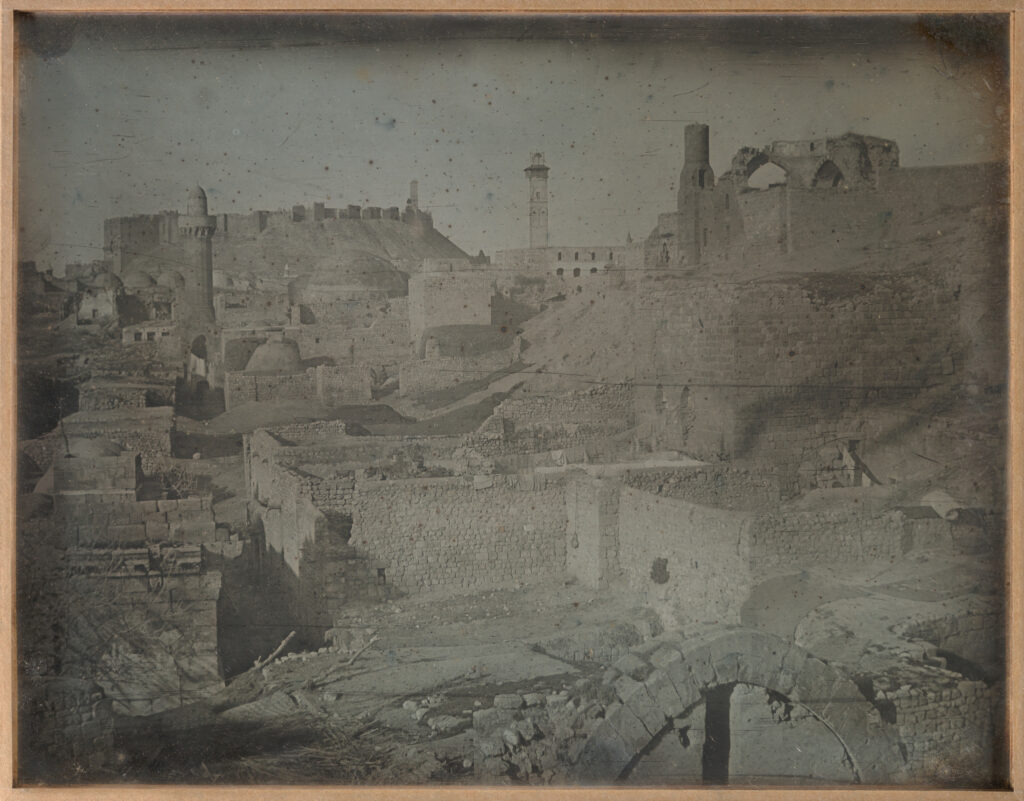
Joseph-Philibert Girault de Prangey (1804-1892), the French scholar, draftsman and amateur archaeologist began using photography to record sites of archaeological and architectural interest as early as 1842. This practice became common through the 1840s-1890s, and more often than not for commercial rather the archaeological purposes.
_MET_DP-1757-027.jpg)
In the early 20th century with advances in photographic processes and equipment significantly improving the practicality and accessibility of production at volume, the use of photography becomes an established component of archaeological surveys, excavations and recording. In the pioneering work of John Garstang (1876-1956) in Anatolia between 1907-1911; Harry Burton (1879-1940) in Egypt between 1922-1934; and O. G. S. Crawford (1886-1957) in England c.1920-1939 we can see the use photography in archaeology developing into a practice that we would religionise today.
Archaeology and photography at the Société Jersiaise
The Société was formed in 1873 and archaeology was one of the first research Sections. It is fair to say the Section led archaeological activities in Jersey throughout the 19th and for a large part of the 20th century. By the mid-point of the 20th century the Section had taken charge of significant excavations and research activities at 11 sites and at numerous megaliths as well as many other minor investigations within the Bailiwick of Jersey.
In 1875 the Executive Committee informed members of the importance of photography for recording the prehistoric and historic environment.2 This call to action clearly aligned with contemporary approaches as noted above. It also notably mirrored the work of amateurs photographers operating in localised groups across England in the photographic survey movement between 1895-1918 with shared the encyclopedic and preservational aims.3 Aims clearly shared by the Société. From this point on, the Société becomes increasingly active in this field, engaging in the practice and collection of photography through its research, publishing, museum and library functions.
The management of photography was formalised in 1927, when a special cabinet was purchased for the Library; with the stated aim of improving the preservation of and access to photographs. A hand written finding aid tilted Société Jersiaise. Photographs is signed by E. F. Guiton and dates to around c.1936. It lists 877 photographs arranged thematically under eight subject headings.
Photographs were mounted on board, generally a stamped block to front of the board provided structured form for recording contextual information (subject heading, number, description, date, and contributor) alongside the image(s), occasionally this block appears on the reverse if the photograph was large.
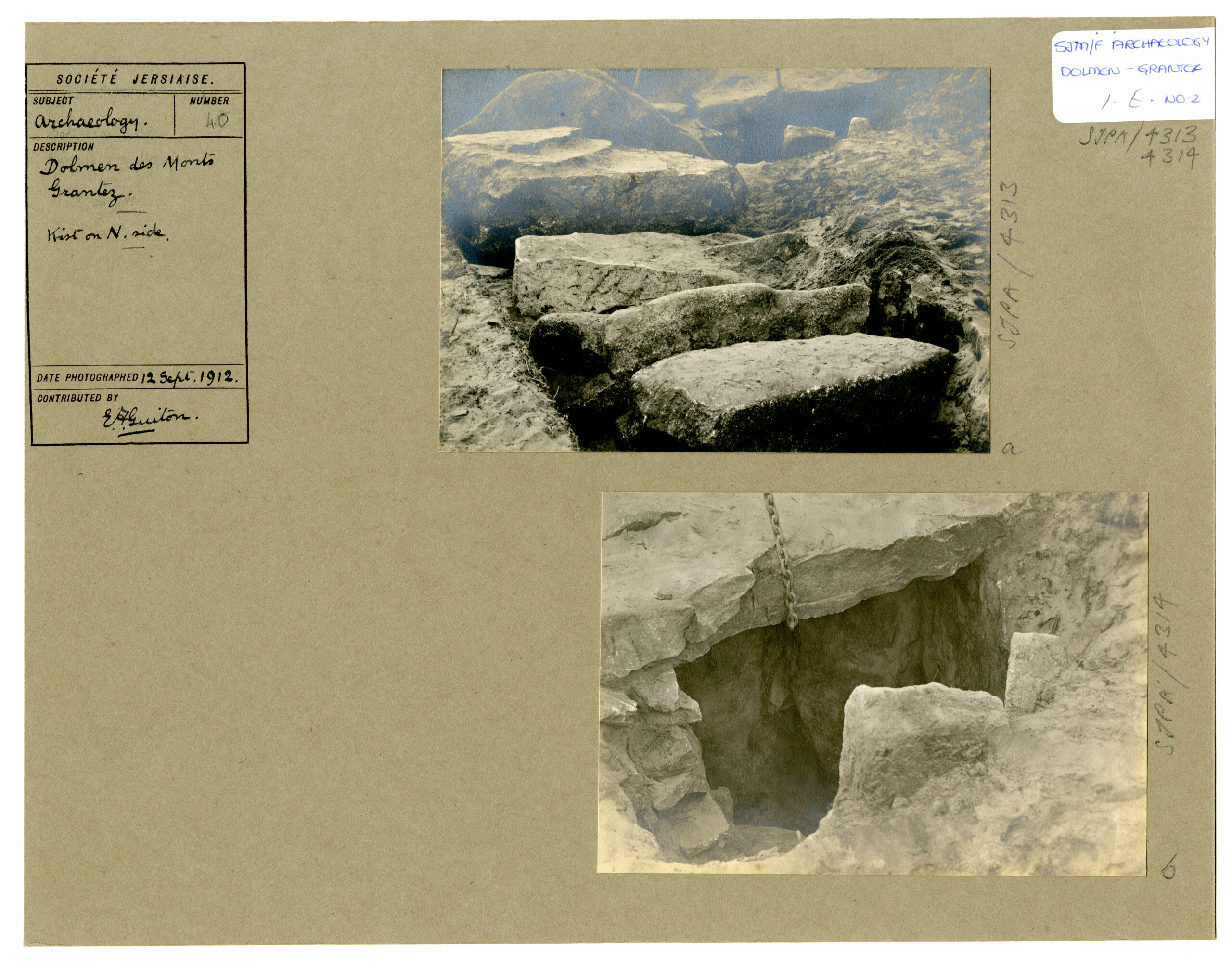
In 1939 the filed photographs in the Library reportedly numbered 1500; by 1957 they had become known as the Guiton Collection, and had grown to number several thousand photographs arranged under 30 main headings supported by subheadings.
It must be noted and can be expanded on elsewhere, that alongside the ever growing ‘Guiton Collection’ in the Library, the Société continued continued to collect other phtographic materials independently within both the context of the Mueum and Library.
Emile F. Guiton and the Société Jersiaise
Emile’s first recorded involvement with the Société is in 1906 when he donates a set of photographs of dolmens to the museum. His brother Stanley Guiton (1875-1935) had been a member since 1896. Stanley was an active botanist, publishing two articles in the Bulletin Annuel de la Société Jersiaise (the Bulletin) – later called the Annual Bulletin of the Société Jersiaise – and a book on collecting and preserving plants. So, Emile would have been aware of the organisation and its work for some time before this donation.
On 25 August 1910 Emile joined Joseph Sinel and E. T. Nicole and four other members of the Société at La Cotte de Saint-Brélade, the palaeolithical site first made famous by the Neanderthal teeth found that year. He likely made four photographs that day, and another three of assembled finds at the Museum. Four of these seven photographs were included in the report on the 1910 excavation published in the Bulletin for 1911. It is of interest to note that Emile had photographed the site before in 1905. There is a single negative surviving, the enclosure is labelled ‘La Cotte, St Brelade – before excavation. 1905?’. The site was excavated in September 1905, however there is no record of Emile being asked to photograph the site prior to the excavation. It is quite possibly coincidental, nevertheless, it demonstrates that Emile was aware of and engaging with what was at the time a lesser known element of Jersey’s archaeological environment.
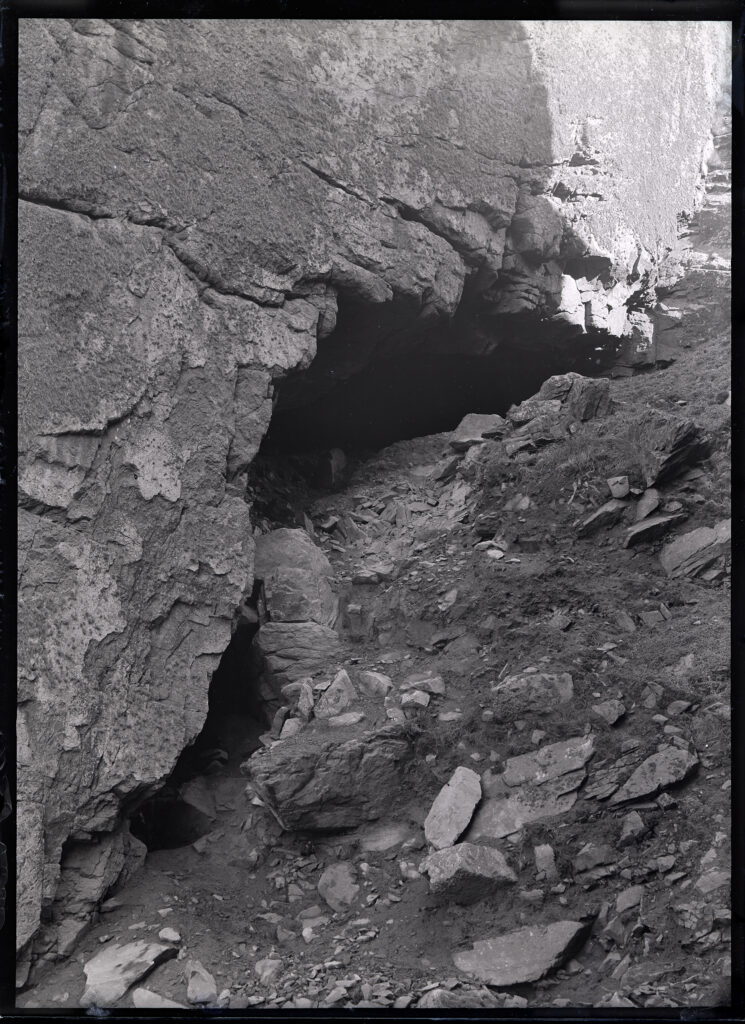
Photographs were not common in the Bulletin before 1911, however photographs by Emile of archaeological sites and finds were published in the Bulletin each year between 1911-1915. In addition to his contributions to numerous reports on La Cotte de Saint-Brélade during these years, his work is also included in reports on excavations at La Motte, La Cotte à la Chèvre, Monts Grantez, and La Houge Mauger, as well as the noting of a neolithic axe found in Trinity. From this we can say with certainty that Emile was already an established and valued participant in the Société’s archaeological activities when in 1914 at the age of 35, he becomes a member of the Société Jersiaise.
He is recorded as taking an active role as an excavator at Le Pinacle (1916) and La Cotte de Saint Brélade (1917-1918), though his primary role remains photographer into the 1920s primarily in the context of the work of the Archaeology and Geology Sections. His most notable contribution of the 1920s being the excavations at La Hougue Bie in 1924.
When the ‘special cabinet’ for photographs (mentioned above) was purchased in 1927 it is Emile who is appointed to manage and develop the collection; a position he seems to have held until at least 1992, around 20 years after his death. Emile went on to hold evermore central and influential roles with the Société – though never seeming interested in the Presidency – he was perhaps drawn to more practical roles. He held the positions of Secretary (1932-46), Editor of the Bulletin (1934-63) and Curator of the Museum (1947-66).
Emile active work as a photographer couples with he various roles he held at the Société place him in somewhat unique position to exert significant influence across the production, management and use of photography at the Société. Throughout this time Emile maintained his own negative archive at his home where he had his darkroom facilities. This served as the source for many images found Library and Museum collection as well as those published in the Bulletin and elsewhere.
Archives and object histories – imagining the archive
As Christina Riggs notes in Photographing Tutankhamen, archival and photographic practices in archaeology are inseparable, and the ongoing care of the resulting archive underpins institutional structures and values.4 Emile’s central role in the production, retention and use of photography at the Société; coupled with access to both his private negative archive and public collection in the Library therefore provides us with an incredible opportunity to interrogate these underlying structures, to understand the role and development of photography in archaeology at Société, and no less importantly Emile the photographer.
In order to do this it is essential to understand the archive not just as it exists now but how it has existed in the past. Much of the material this series considers is over a century old, the means of access and categorisation are in many ways alien to those in which they were first used and managed. All three key sources (the Gution Collection, the Guiton Negative Archive and the published sources) are to a greater or lesser degree fragmentary which complicates an analysis. However, a study of their material properties, surviving catalogues, metadata and references in secondary sources allow us to reconstruct the archive conceptually at particaular points in its history. In doing so we can study the development of their structures, subjects, consumption, history and categorisation. Alongside this imagining of the archive, the materiality and presentational form of the photographs contained within the surviving archives and sources are central to supporting this analysis of the structures and values they reflect. The archive cannot be reduced to images on a screen. As Elizabeth Edwards and Janice Hart note, ‘the material and social existence of photographs as objects forestalls such a reduction’.5
- Sontag, Susan. On Photography (Penguin Books, 2008) p. 5 ↩︎
- ‘Deuxième Rapport Annuel du Comité de la Société Jersiaise’, ABSJ, 1.2, 1876, pp. 22-28 (p. 28) ↩︎
- Edwards, Elizabeth. The Camera as Historian: amateur photographers and historical imagination, 1885-1918, (Duke University Press, 2012) p.5 ↩︎
- Riggs, Christina. Photographing Tutankhamen (Routledge, 2020) p.38 ↩︎
- Edwards, Elizabeth & Hart, Janice. Photographs Objects Histories: on the Materiality of Images, (Routledge, 2004) p.15 ↩︎
Leave a Reply